Recent studies show that learners retain an incredible 75% of information when they practice within a simulation. This is a massive leap from the 10% retention rate seen in traditional reading methods. This efficiency is exactly why virtual reality has become a cornerstone of modern business training.
By integrating ai-generated learner analytics for vr programs, you can transform static exercises into dynamic, personalized journeys. This powerful technology uses smart learning analytics to track every movement and decision in real time. These tools provide the deep insights you need to understand how your team interacts with digital environments.
You can now leverage learning analytics to observe how people solve problems within immersive worlds. This rich data helps you pinpoint exactly where a person excels or where they struggle during their learning path. High-quality analytics provide the clarity required to improve organizational performance instantly.
Through advanced learning analytics, you see the nuances of behavior that traditional testing misses entirely. These analytics tools turn complex data into a clear roadmap for professional growth and skill learning. You ensure that your learning strategy is not just an event, but a measurable path to total mastery.
Every piece of data gathered helps you refine the learning experience for the future. You are not just teaching skills; you are building a reality where learning is perfectly tailored to every individual user.
Key Takeaways
- Discover how AI-driven data provides deep insights into learner behavior and engagement.
- Understand why combining artificial intelligence and VR boosts training effectiveness.
- Learn how real-time data collection allows for highly personalized learning experiences.
- Explore how organizations maximize their ROI through measurable skill development.
- See how cutting-edge technology captures complex performance metrics in virtual worlds.
- Achieve better knowledge retention by adapting simulations to individual learning styles.
The Evolution of VR Training in Modern Education
In a world where technology moves fast, you need training that keeps pace with your team’s needs. Traditional teaching methods often struggle to keep students interested in static material. You are now witnessing a major shift toward immersive technology that captures attention like never before.
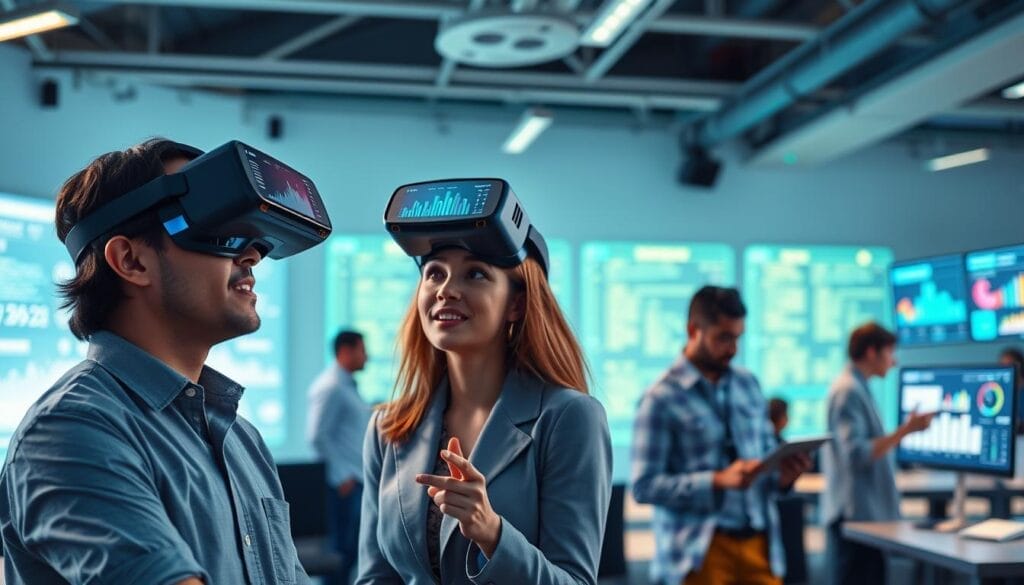
Modern organizations are moving away from passive lectures to embrace active, hands-on participation. This evolution ensures that your training programs are not just informative but truly transformative for every participant. By removing the walls of a standard classroom, you open a universe of possibilities for skill acquisition.
From Traditional Learning to Immersive Experiences
VR changes the game by putting students in the center of the action. Instead of reading about a task, they perform it in a safe, controlled environment. This creates a high level of engagement that traditional e-learning simply cannot match.
Data from PwC shows that VR-trained employees are four times more focused than their classroom peers. Because the headset controls visual and auditory senses, students do not get distracted by their surroundings. You can reinforce an immersive story that keeps them locked into the subject matter from start to finish.
Why VR Training Outperforms Conventional Methods
The secret to VR’s success lies in how it activates multiple brain regions at the same time. This neurological stimulation builds a deeper understanding of complex topics. When you use learning analytics, you can actually see how these stronger memory pathways lead to better performance outcomes.
Immersion helps with retention by creating emotional connections to the material. You can reduce total learning time by up to 400% while seeing a massive spike in comprehension. This efficiency allows your team to master new skills and apply them to real-world challenges immediately. Advanced learning analytics provide the insights you need to refine these experiences for maximum impact.
VR training allows us to fail safely, learn quickly, and succeed faster in the real world.
| Training Feature | Traditional E-Learning | VR Immersive Training |
|---|---|---|
| Focus Level | Low (Easily Distracted) | 4x Higher Focus |
| Knowledge Retention | Passive Recognition | Superior Long-term Memory |
| Data Insights | Basic Completion Rates | Advanced learning analytics |
| Learning Speed | Standard Pace | Up to 400% Faster |
Understanding AI-Generated Learner Analytics for VR Programs

Imagine a world where AI-generated learner analytics for VR programs offer a window into the cognitive process of every trainee. You no longer have to guess how your team learns or where they struggle during complex tasks. By using these advanced digital tools, you turn every virtual interaction into a clear roadmap for professional success and mastery. This modern analytics approach allows you to see exactly how knowledge translates into action.
What Are Learner Analytics in Virtual Reality?
In the expansive world of virtual reality, performance metrics go far beyond simple quiz scores or basic completion rates. Learning analytics represent a collection of rich, immersive data points captured during active participation in digital environments. These sophisticated systems track precise user movements, eye focus, and response times with incredible accuracy.
You gain data-driven insights into how a student manipulates objects or solves complex problems in real-time. For example, in a VR physics simulation, the technology records how a learner approaches a gravity-based challenge. It captures the specific way they manipulate tools to reach a solution.
This deep level of data allows you to identify specific misconceptions or areas where a trainee needs extra support. High-quality analytics empower you to make informed decisions that significantly enhance the overall training experience. You can finally see the *learning process* as it happens, not just the final result.
How AI Transforms Data Collection in VR Environments
Artificial intelligence has revolutionized how we gather information by enabling passive and continuous monitoring of every participant. You can now observe multidimensional behaviors without disrupting the flow of the immersive experience. Sophisticated AI technologies use computer vision and natural language processing to detect patterns a human instructor might miss.
Machine learning analytics algorithms process massive data sets instantly to provide immediate feedback. These smart algorithms identify subtle behavioral patterns that reveal a learner’s confidence level or frustration points. This real-time transformation of raw movement into actionable intelligence changes the way you manage talent.
These systems adapt their priorities based on emerging patterns, focusing your attention on the most relevant metrics. You ensure your organization stays at the cutting edge of professional development by using these intelligent solutions. AI does more than just collect numbers; it creates a personalized narrative of growth for every single user in your program.
Key Benefits of AI Analytics in VR Training
The integration of intelligent data tracking offers a massive leap forward for immersive training results. You can now see exactly how your team interacts with digital worlds to ensure every second counts. This clarity allows you to transform abstract data into actionable growth strategies.
Enhanced Engagement and Knowledge Retention
AI analytics track exactly where learners look and how they move through a scenario. This deep insight helps you create learning experiences that truly captivate the senses. When users feel fully immersed, they retain information much longer than they would through 2D videos.
Interactive elements in VR trigger emotional responses that strengthen long-term memory. By analyzing these specific moments, you can refine your training modules for maximum impact. This ensures that your workforce remains sharp and ready for any high-stakes challenge.
Real-Time Performance Assessment
Forget waiting for annual reviews or post-session test scores to see progress. Real-time assessment provides instant feedback within the virtual space as the task unfolds. You can monitor progress as it happens, allowing for immediate course correction and faster mastery.
This rapid feedback loop accelerates the learning curve significantly for every participant. It builds confidence in your team by validating their skills instantly during the simulation. Every data point gathered serves as a stepping stone toward professional excellence and technical precision.
Personalized Learning Pathways
Every person brings unique needs and different learning styles to the table. AI analytics enable personalized learning by identifying these individual traits automatically during a session. The system then adjusts the content to match each specific learning style without manual intervention.

This tailored approach identifies knowledge gaps in real-time to save you valuable resources. It then prescribes remedial practice right when the student requires it most within the environment. Such precision minimizes redundant instruction and respects your team’s limited time.
Adaptive pathways ensure that the challenge level remains optimal for every single person. This prevents boredom for advanced users while supporting those who might need extra help. You create a more inclusive and learning-focused system that maximizes outcomes for everyone involved.
| Feature | Traditional Training | AI-VR Training |
|---|---|---|
| Feedback Speed | Delayed / Post-Exam | Instant / Real-Time |
| User Personalization | One-Size-Fits-All | Adaptive Pathways |
| Data Granularity | Basic Pass/Fail | Biometric & Behavioral |
| Skill Retention | Low / Passive | High / Active |
Implementing AI Analytics in Your VR Training Program
You are ready to unlock the full potential of your learners by weaving advanced intelligence into every virtual interaction. Moving toward a sophisticated setup requires more than just the latest headset; it demands a clear roadmap for your software stack. By integrating these systems, you transform simple exercises into a powerful engine for analytics and growth.
Essential Components for Successful Integration
Starting your journey requires the right mix of infrastructure and vision. You need robust tools that can handle high-speed information processing without lagging or crashing. Your training content must be designed from the ground up to trigger specific behaviors that the AI can measure effectively.
Integrating these systems allows you to generate data-driven insights that guide your future business investments. You can refine your approach using data-driven course design to ensure every virtual module hits the mark. These insights act as a digital compass, pointing you toward the most effective teaching methods for your team.
High-quality content serves as the heartbeat of your virtual world. You should focus on creating experiences where every choice is recorded and analyzed.
As with any data-driven field, ethics play a crucial role in VR analytics. Collecting and analyzing student data raises concerns about privacy, security, and consent.
Data Collection Strategies and Best Practices
Successful implementation depends entirely on how you capture every digital footprint within the simulation. You must develop a plan that balances detailed learning analytics with strict user privacy. Start by capturing how users look at objects or move through a room to identify points of confusion or interest.

Establish strong governance to protect the data you gather from your employees. You should collect both quantitative metrics, like completion times, and qualitative feedback to see the full picture of the learning journey. This dual approach ensures you understand the “why” behind every trainee action.
Always validate and clean your interaction data to keep your learning analytics accurate and useful. If you find errors in the logs, fix them before they skew your final reports. This commitment to accuracy ensures that your training remains a high-value asset for your organization’s future success.
| Implementation Pillar | Core Activity | Expected Outcome |
|---|---|---|
| Technical Infrastructure | Software integration | Reliable information flow |
| Behavioral Tracking | Gaze and movement analysis | Deep engagement metrics |
| Ethical Oversight | Governance protocols | Secure and trusted systems |
Overcoming Challenges in AI-VR Analytics Implementation
As you integrate these cutting-edge tools, you will encounter hurdles that demand innovative thinking and strategic planning. Scaling your vision requires a clear roadmap to handle the complexities of the digital landscape. You can transform these obstacles into growth opportunities by choosing the right infrastructure.
Every technological shift brings its own set of barriers. However, identifying these early allows you to build a more resilient program. Your commitment to innovation will ensure a seamless transition for every learner involved.
Technical Hurdles and Solutions
Integrating high-fidelity VR with real-time learning analytics often stresses existing hardware. You might face issues with information latency or hardware compatibility across different headsets. Processing vast amounts of data requires robust cloud computing and high-speed connections.

Engineers can solve these bottlenecks by using edge computing. This reduces the lag during sessions, keeping students focused and engaged. Strong API frameworks also help bridge the gap between VR platforms and your existing education software.
Furthermore, standardizing your tech stack simplifies the maintenance process. Continuous testing ensures that your learning analytics remain accurate and actionable. By optimizing your network, you provide a frictionless experience that empowers your workforce.
Addressing Privacy and Ethical Considerations
Ethics play a vital role in the success of any analytics platform. Collecting behavioral and biometric information raises important concerns regarding privacy and security. You must prioritize protection to ensure all information is handled with the utmost care.
Institutions should adopt a transparent approach by obtaining informed consent from students. You can foster trust by explaining how you use their information. Exploring ai-in-leadership-ethics-training-through-immersive-simulations helps leaders build a strong ethical framework for their teams.
Proper anonymization minimizes the risk of breaches for all students. Secure encryption protocols keep the privacy of every learner intact. By following these best practices, you create a safe environment where advanced analytics drive progress without compromising values.
| Challenge Area | Primary Obstacle | Strategic Solution |
|---|---|---|
| Data Security | Sensitive Biometric Risk | End-to-End Encryption |
| System Integration | Legacy Software Lag | Custom API Middleware |
| User Trust | Lack of Transparency | Informed Consent Portals |
Real-World Applications: Success Stories and Case Studies
Explore how leading pioneers are rewriting the rulebook of professional development using advanced data insights. You are witnessing a shift where high-stakes environments become safe zones for growth and experimentation. This evolution spans from the boardroom to the lecture hall, proving that the world of training has changed forever.
Corporate Training Transformations
Global enterprises are ditching static learning platforms for dynamic, AI-powered environments. You can now track every hand movement and decision-making process in high-pressure scenarios. These platforms provide a level of detail that traditional workshops simply cannot match.
One major logistics firm used these tools to reduce onboarding time by 40%. Their learners gained confidence in a virtual warehouse before ever stepping onto the physical floor. This ensures that every worker is ready for peak performance on day one.
| Industry | Primary Goal | Outcome |
|---|---|---|
| Logistics | Reduce Onboarding Time | 40% Faster Readiness |
| Healthcare | Surgical Precision | 15% Error Reduction |
| Retail | Customer De-escalation | 90% Confidence Boost |
Educational Institution Implementations
Forward-thinking schools are leading the way in modern education. A recent university study found that combining simulations with deep analytics drastically boosted student performance in science courses. This data gave teachers insights into specific misconceptions held by students.
Medical and engineering programs use these tools to bridge the gap between theory and practice. By analyzing how students interact with complex systems, faculty can provide targeted interventions. This approach creates graduates who excel in their professional careers from the very start.
The data collected from VR interactions provides valuable insights into student learning strategies and misconceptions, enabling more targeted teaching interventions.
Educational leaders use these metrics to validate their curriculum to accreditation bodies. You can see how students master skills in real-time, ensuring every dollar spent on technology delivers a high return. Modern education is finally becoming as personalized as the people it serves.
Future Trends in AI-Powered VR Learning Analytics
Imagine a world where your learning programs anticipate user needs before they even arise. The horizon of immersive education is shifting toward a highly predictive and interconnected ecosystem that goes beyond simple data tracking.
Emerging Technologies and Integration Possibilities
The future of immersive environments lies in adaptive intelligence that moves away from a one-size-fits-all approach. AI algorithms will soon analyze how learners interact with objects to identify a specific learning style in real-time. This allows the system to adjust the environment to match various learning styles instantly.
You can expect systems that provide immediate, haptic feedback based on cognitive load and emotional responses. This instant feedback ensures that the learning process remains challenging but not overwhelming for the user. Advanced AI will also foster social collaboration by grouping students based on shared interests or skill gaps.
These breakthroughs show how AI and AR/VR are transforming the digital into a space for continuous skill development. By tailoring every interaction, these platforms help teams keep pace with a rapidly evolving global market.
Preparing Your Organization for Next-Generation VR Training
To stay ahead, you must develop a strategic roadmap that prioritizes innovation and scalable training infrastructure. Building a robust data architecture is essential to support the advanced analytics capabilities that will soon become standard. Your learning strategy should focus on more than just technology; it requires a culture of constant improvement.
Consider the following steps to prepare your team for this transformation:
- Build Technical Infrastructure: Design data systems that can handle high-velocity inputs from immersive sensors and AI engines.
- Upskill Your Team: Ensure your instructional designers and data scientists understand the nuances of immersive learning.
- Implement Change Management: Use analytics-driven insights to help your organization embrace new, data-heavy decision-making processes.
- Identify User Needs: Regularly assess the unique needs of your learners to ensure your VR modules remain relevant and impactful.
By focusing on these areas, you empower your workforce to master unique skills through a dynamic and engaging journey. The future belongs to those who use data to bridge the gap between potential and performance.
Conclusion: Revolutionize Your Training with Hyperspace
Revolutionizing your training approach starts with high-quality data and deep insights into learner behavior. By integrating AI-powered learning analytics, you can transform static modules into dynamic, personalized learning paths. This evolution ensures that every learner receives the support they need to master complex tasks in a virtual world.
Hyperspace leads this transformation by offering advanced analytics that reveal hidden patterns. You can identify specific areas improvement and track engagement in real time. These experiences provide feedback that significantly boosts knowledge retention and overall learning efficiency across your organization.
Our platform focuses on the unique needs of your learners. We optimize learning experiences to ensure better educational outcomes and deeper understanding. With our resources, your education strategy will excel in the modern digital age by empowering every employee.
Step into the future of personalized learning with the most innovative tools available. Discover how we address organizational needs through automated feedback and behavioral patterns. It is essential to refine specific areas and maximize your experience to remain competitive.
Using deep analytics helps empower all learners. Our learning analytics provide the best support for growth. This learning model adapts to your specific team requirements effortlessly. Successful learning requires a modern touch, and every learning session builds a better, more capable workforce.
Hyperspace delivers the ultimate environment for growth and innovation. Join the ranks of forward-thinking companies that prioritize human potential. Start your free trial today and experience the future with Hyperspace. Visit http://hyperspace.mv/get-starter to begin your transformation.
| Training Feature | Traditional Methods | Hyperspace AI-VR Solution |
|---|---|---|
| Feedback Speed | Delayed or Manual | Instant & Automated |
| Learning Paths | Static/Linear | Dynamic & Personalized |
| Data Depth | Basic Completion | Deep Behavioral Patterns |
| Knowledge Retention | Low/Passive | High/Immersive |