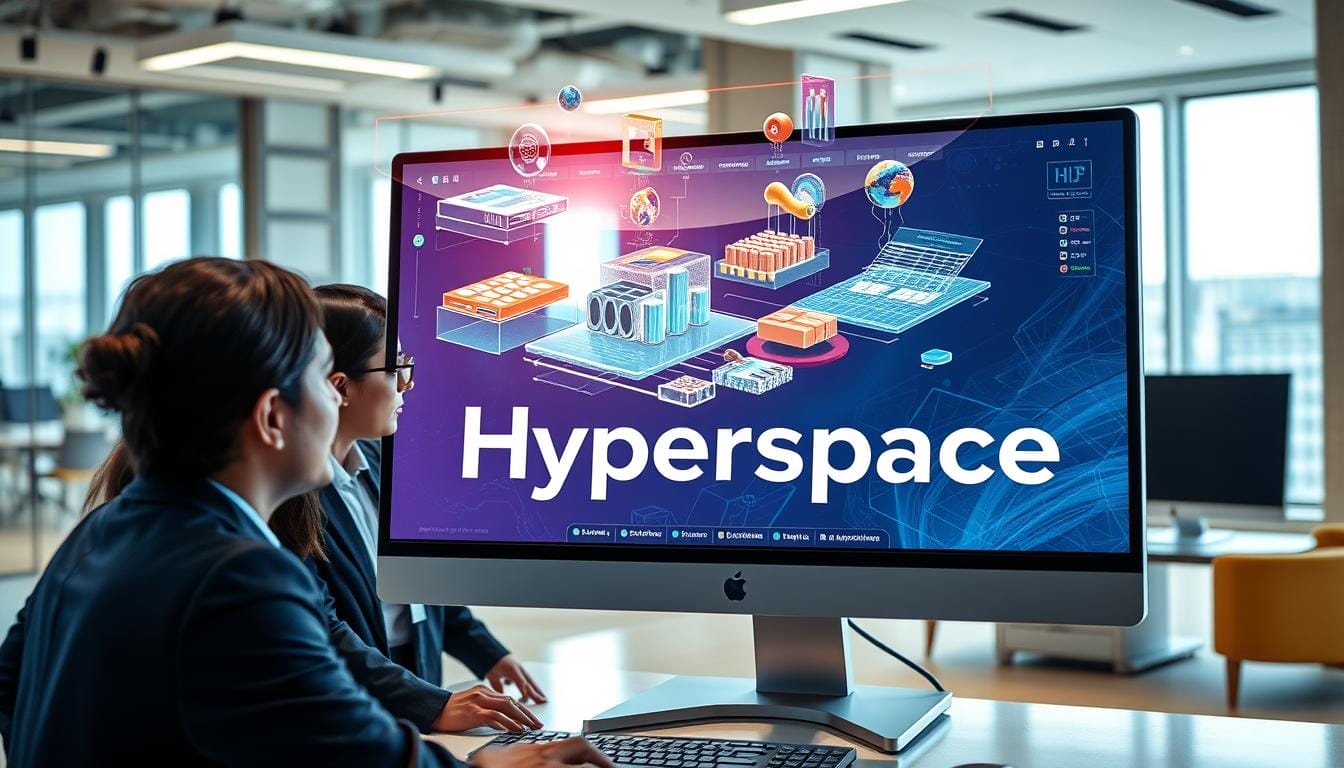
You can now step directly into a digital world where education comes alive and boundaries vanish. This innovative method uses VR and AR to place you in interactive training environments. It transforms how people gain knowledge by focusing on active participation rather than just listening.
These experiences allow you to practice skills in safe, simulated spaces instead of just reading notes. Modern training solutions help people master new tasks four times faster than traditional methods. You stay sharp and focused through active multi-sensory engagement.
Forward-thinking companies are adopting training programs to improve performance and gather better data. We will explore how to pick the right training for your specific needs. This guide helps you build the future of your organization through training today.
Key Takeaways
- Simulation technology uses VR, AR, and MR for hands-on practice.
- Students master skills four times faster than in traditional classrooms.
- Interactive environments lead to higher focus and better retention.
- Organizations build critical skills in risk-free, simulated settings.
- Advanced tools provide actionable data on learner performance.
- New technology turns passive listeners into active participants.
Understanding Immersive Learning Software
Stepping into the digital age requires a deep dive into how immersive learning software reshapes the way you absorb information. You are no longer a mere spectator in your professional growth. You are now the creator of your own success through high-tech interaction.
By leveraging these tools, you can transform static content into dynamic realities. This shift empowers you to master complex skills in a world designed for your progress. It is time to explore the mechanics behind this educational revolution.
What Is Immersive Learning?
Immersive learning uses advanced digital tools like AR, VR, and simulation training to build a artificial world. This setting allows for total engagement by making you feel present within the digital environment. It moves beyond simple observation to provide a truly powerful experience.

This approach creates fully interactive spaces where you engage with content through multiple senses. These scenarios mirror real-world situations, allowing you to explore non-linear solutions. In these environments, your actions reveal multiple possibilities rather than just one right answer.
You can discover various experiential learning formats that focus on active doing. This method ensures that every lesson stays with you for the long term. It bridges the gap between theoretical knowledge and practical application seamlessly.
“Learning is not a spectator sport; it requires active participation and emotional connection to truly stick.”
The Evolution of Learning Technologies
The history of learning technologies shows a steady march toward total engagement. It started with text-heavy manuals that were often hard to digest. Later, multimedia like video and audio improved the training process slightly by adding visual cues.
Today, modern learning technologies adapt to your individual needs and behaviors in real-time. We have moved from passive observation to fully interactive spaces. These platforms enable a contextual understanding that theory alone can never reach.
- Text-Based: Manuals and simple documents.
- Multimedia: Videos, audio, and basic quizzes.
- Immersive: Fully interactive VR and AR environments.
How Immersive Learning Differs from Traditional Methods
Traditional training methods often rely on the passive consumption of facts. In contrast, immersive learning places you at the center of the story. You must make active decisions and face the outcomes of your choices immediately.
Modern platforms use simulation training to let you practice skills safely. You can make mistakes and see the consequences without any real-world risks. This active learning style significantly improves how you apply your new skills in the workplace.
| Feature | Traditional Methods | Immersive Systems |
|---|---|---|
| Engagement | Passive Consumption | Active Participation |
| Risk Level | Theoretical Only | Zero Risk Practice |
| Feedback | Delayed Results | Instant Consequences |
Ultimately, this innovative approach transforms training into a dynamic and rewarding quest. It builds professional confidence by letting you prove your abilities in a virtual space. Your path to mastery becomes much clearer, faster, and more exciting.
Key Technologies Powering Immersive Learning
To master the art of modern training, you must first understand the cutting-edge technology that makes these experiences possible. These digital tools turn passive observers into active participants by blurring the lines between the digital and physical worlds. You have the power to create training that is not just seen, but lived and felt.
Virtual Reality (VR) Learning Environments

Virtual reality is an immersive technology that transports you to a different environment. This space might be a real-world setting or a completely imaginary landscape. Virtual reality creates completely immersive learning environments where your team is transported to simulated worlds through specialized headsets.
These devices block out the physical room to enable deep engagement with complex concepts. Studies show that learners are nearly four times more emotionally connected to material in these virtual settings. By using this tool, you can build safe spaces for high-stakes practice and complex skill simulations.
Augmented Reality (AR) in Education

Augmented reality enhances real-world surroundings by overlaying digital information onto your actual environment. Unlike virtual reality, which creates an entirely artificial space, AR allows learners to interact with physical and digital elements simultaneously. You can access these experiences through smartphones, tablets, or specialized glasses.
This approach proves extraordinarily effective for just-in-time training in the workplace. It enables your staff to access vital data while they examine equipment in their actual work environment. You can provide instant guidance exactly when and where your team needs it most.
Mixed Reality (MR) Applications

Mixed reality applications blend elements of both VR and augmented reality to create a hybrid space. In these scenarios, physical and digital objects coexist and interact in real-time. This offers sophisticated training possibilities for complex procedural learning and collaborative problem-solving.
Imagine your team working together on a holographic model that responds to their physical touch. Mixed reality solutions are the ultimate way to bridge the gap between digital theory and physical practice. You can transform any ordinary room into a dynamic, interactive workspace that inspires innovation.
Benefits of Immersive Learning Software
The move to simulated environments brings a suite of powerful advantages that traditional methods simply cannot match. You are not just upgrading your tools; you are reimagining what is possible for your team. These benefits extend far beyond simple efficiency, touching the very heart of how people understand and apply new skills.

Enhanced Engagement and Knowledge Retention
Multi-sensory learning experiences capture attention in ways a static slide deck never could. You will notice that engagement levels skyrocket when your team steps into a fully realized virtual world. Studies show that learners are nearly four times more emotionally connected to content in these settings than in physical classrooms.
This deep connection creates stronger neural pathways for long-term memory. You can expect up to 275% higher confidence in applying skills after these sessions. Because learners must solve problems in real-time, the information actually sticks.
“Immersive learning requires learners to make decisions, solve problems, and think critically—and this leads to better retention.”
Safe Practice Environments for Critical Skills
One of the most vital benefits is the ability to fail without real-world consequences. You can build high-stakes simulations where mistakes provide valuable lessons rather than dangerous risks. This environment allows for repeated practice of high-risk tasks until your team achieves total mastery.
Eliminating the costs associated with physical errors or equipment damage saves your organization significant resources. You provide a playground for curiosity where your team can explore complex scenarios safely. This hands-on approach is one of the key benefits of modern simulation tools that drive ROI.
Personalized Learning Experiences
The software adapts to individual progress, creating truly custom learning experiences. It automatically adjusts the difficulty level based on how well a user performs. You no longer have to worry about a “one size fits all” approach that leaves some people behind. This ensures every individual moves at a pace that maximizes their potential.
Data-Driven Performance Insights
You gain unprecedented visibility into how your team grows through advanced analytics. The software tracks performance metrics that remain invisible in traditional training formats. You can identify specific decision-making patterns and knowledge gaps instantly.
These insights allow you to refine your strategy based on actual performance data. This level of detail is one of the standout benefits for any forward-thinking leader. You can finally measure the direct impact of training on your bottom line.
| Feature | Traditional Training | Immersive Learning |
|---|---|---|
| Emotional Connection | Low / Passive | 4x Higher Connection |
| Skill Confidence | Baseline Growth | 275% Improvement |
| Risk Level | High in Field | Zero in Simulation |
| Feedback Loop | Delayed Results | Instant & Data-Driven |
Applications Across Different Industries
Step into a world where diverse industries harness spatial reality to redefine what it means to learn and excel. You are witnessing a massive shift as businesses move away from static manuals and embrace interactive digital worlds. These immersive learning experiences allow you to bridge the gap between theory and actual practice. Every modern industry now has the power to transform its workforce through highly realistic simulations.
Corporate Growth and Talent Development
Many companies now use these tools to build stronger leaders and more effective sales teams. You can place your staff in realistic scenarios where they practice difficult conversations or close high-stakes deals. This approach helps workers develop soft skills in a way that traditional videos simply cannot match. By enhancing virtual training with AI technologies, you can create even more dynamic interactions. This evolution ensures your training programs remain relevant and highly personalized for every employee.
Healthcare and Medical Science
In the medical field, the stakes are always high. Medical companies and hospitals are turning to VR to simulate complex surgeries. This allows students to repeat intricate procedures as many times as needed in a risk-free environment. Precision is the key to success in medicine, and simulation provides that edge. Surgeons can practice on 3D anatomical models before they ever step into an operating room. This type of high-fidelity training builds muscle memory and confidence. It ultimately leads to better patient outcomes and fewer errors in the real world.
Manufacturing and Industrial Excellence
Industrial workers often face dangerous conditions on the job. These programs allow them to experience hazardous scenarios without any actual physical risk. Employees learn to operate heavy machinery and follow safety protocols in a digital twin of their factory. This specialized industry application reduces downtime and keeps your team safe during their initial training phases. It transforms the way you approach safety and technical efficiency on the factory floor.
Education and Academic Settings
Modern classrooms are no longer bound by four physical walls. Students can take virtual field trips to distant planets or ancient ruins through immersive learning experiences. This technology makes abstract concepts tangible and exciting for learners of all ages. Schools are using these tools to foster collaboration and boost student engagement. This new era of training empowers teachers to create unforgettable lessons that stick with students for a lifetime.
| Industry | Primary Application | Key Benefit |
|---|---|---|
| Corporate | Leadership and Sales | Improved Soft Skills |
| Healthcare | Surgical Simulation | Patient Safety |
| Manufacturing | Equipment Operation | Risk Mitigation |
The versatility of these tools allows for deep customization across many sectors. You can tailor the environment to meet the specific needs of your team. Here are a few ways different sectors benefit:
- Retail: Staff practice customer service and de-escalation in virtual stores.
- Hospitality: Managers learn to handle busy check-in desks during peak hours.
- Construction: Teams visualize blueprints in 3D to identify structural issues early.
- Finance: Employees simulate high-pressure trading environments or security audits.
Top Immersive Learning Software Solutions
Discovering the market’s elite platforms empowers you to transform traditional education into high-impact digital experiences. You want to partner with companies that understand your specific goals and technical needs. These high-performance solutions reflect the best of modern innovation and have earned stellar reviews from industry experts.
SweetRush

Overview
SweetRush is a tech-agnostic provider ready to help you validate and scale effective training. They combine an L&D-first mindset with cutting-edge technology to solve complex business problems. Their team focuses on innovation to ensure your programs remain relevant and impactful.
Key Features
They offer custom solutions that include content for AI-powered simulations. These work seamlessly across VR headsets, desktops, and mobile devices. Their impressive reviews mention their 56 Gold Brandon Hall awards for excellence in design.
Best For
Organizations looking for highly customized and creative companies to build specialized training. Their reviews reflect a strong ability to handle large-scale enterprise projects with high emotional intelligence.
ELB Learning’s CenarioVR

Overview
CenarioVR is recognized as one of the most user-friendly tools for virtual reality course creation. It empowers instructional designers to build immersive experiences without needing specialized technical skills. You can quickly turn static ideas into living environments.
Key Features
This platform allows you to publish interactive content to mobile phones, desktops, or headsets with one click. It includes features for gamification, video practice, and live coaching to enhance the experience. Industry reviews highlight how fast users can deploy new modules.
Best For
Internal companies and design teams that need to create VR training rapidly and affordably. It is the perfect choice for teams moving away from traditional slide-based learning.
Learning Pool

Overview
Learning Pool delivers innovative solutions with a focus on closing employee knowledge gaps. They bring extensive expertise to every project, ensuring your team masters vital skills quickly. Their approach relies on proven success in highly regulated sectors.
Key Features
They utilize advanced tools to build high-engagement ai-enabled immersive learning environments that drive results. Their content includes successful projects like the SGN Gas Engineers Assessment. Positive reviews often mention their ability to increase learner engagement in the pharmaceutical industry.
Best For
Enterprises in utilities and healthcare that require evidence-based training and measurable performance growth. These reviews prove their reliability in high-stakes environments.
AllenComm

Overview
AllenComm combines deep instructional design expertise with agency-level creative teams. They develop solutions that simulate real-world scenarios with incredible precision and detail. You get a partner that understands how to motivate adult learners through storytelling.
Key Features
Their team creates content that mimics high-pressure situations, such as responder safety training. This earns them consistent praise and strong reviews from organizations like the NFPA. Many companies trust them to bridge the gap between theory and hands-on practice.
Best For
Businesses that need high-fidelity simulations for safety and technical skills training. Their creative approach ensures that learners stay focused and retain vital information.
Cornerstone Immerse

Overview
Cornerstone Immerse offers a comprehensive platform designed to enhance career mobility for your workforce. It allows your organization to map careers and close skills gaps in real-time. You can empower your learners with the confidence to succeed in any role.
Key Features
The platform enables practice without pressure in realistic customer service scenarios. It tracks progress automatically and provides data to improve your content strategy. Top companies use it to provide virtual hands-on learning that scales globally.
Best For
HR leaders who want to improve employee retention and track skill development through immersive reviews and data. It is ideal for fostering a culture of continuous improvement.
Implementation Considerations for Immersive Learning
Transforming your training landscape into an interactive digital space starts with a clear plan for adoption. You must define the specific outcomes you want your team to achieve before deploying any tools. This strategic approach ensures that every digital interaction drives real business value and improves performance.
Building an immersive learning environment begins with a roadmap of your desired results. You should guide the design process by focusing on how the material will solve current skill gaps. By analyzing your audience early, you can create a journey that resonates with every user in your organization.
Technical Requirements and Infrastructure
You must evaluate your current hardware and network speed to ensure they can handle high-definition simulations. Successful rollouts depend on hardware specifications and the physical space available for your team to move safely. Robust infrastructure is the backbone of any successful technology rollout.
Consider how your network handles data spikes when multiple users enter the same simulation simultaneously. Scalability is a key factor if you plan to expand these tools across different departments. Evaluating these technical needs early prevents costly delays during the actual launch phase.
Content Development Strategies
Effective content development means creating experiences that use the full power of your chosen technology. You should blend storytelling with interactive tasks that mirror real-world challenges your employees face. Engaging visuals and clear text must work together to guide learners effectively through the experience.
“Innovation distinguishes between a leader and a follower.”
Your approach should focus on a seamless integration of sensory elements and educational goals. This ensures that the immersive parts of the lesson enhance the learning rather than distracting from it. Always prioritize interactive elements that allow users to practice critical skills in a safe space.
Integration with Existing Learning Management Systems
You must ensure your new software talks to your existing learning management system to keep data organized. This connection allows you to gather performance metrics and track how your employees are progressing. A unified user experience helps everyone transition smoothly from traditional modules to new digital realities.
Using a phased approach allows you to test the waters before a full-scale launch. You can refine your content development processes as you grow your immersive environment across the company. Modern learning management thrives when it adopts a scalable and flexible technology stack.
As you expand, focus on maintaining content quality and relevance for all users. Continually assessing the suitability of your material ensures your immersive environment remains a cutting-edge tool for growth. This commitment to quality keeps your team engaged and ready for future challenges.
| Implementation Factor | Primary Focus Area | Strategic Value |
|---|---|---|
| Infrastructure Needs | Hardware and Space | Ensures user safety and performance |
| Content Strategy | Storytelling Development | Maximizes engagement and retention |
| System Synchronization | LMS Management | Provides clear data-driven insights |
| Scalability Technology | Network Capacity | Supports long-term organizational growth |
Measuring ROI and Effectiveness
You can turn abstract educational goals into concrete business assets by measuring the right outcomes. High-impact learning tools must prove their worth through clear data and visible growth. By focusing on specific results, you validate your investment and inspire further innovation.
Performance Metrics to Track
Establishing clear metrics is the first step to understanding the success of your learning programs. You should implement pre- and post-training assessments to quantify exact knowledge gains. These scores allow you to compare your digital initiatives against traditional classroom methods accurately.
Advanced analytics provide deep insights into how users make decisions during their training sessions. You should track completion rates and real-world application success to see how skills transfer. This data ensures that your performance benchmarks remain high and relevant.
| Metric Type | Traditional Training | Immersive Learning | Business Impact |
|---|---|---|---|
| Knowledge Retention | Low (10-20%) | High (75-90%) | Reduced retraining costs |
| Completion Speed | Slow | Rapid | Faster productivity gains |
| User Engagement | Passive | Active | Higher employee morale |
Cost-Benefit Analysis
Your analysis must account for hardware costs and content development alongside indirect benefits. You should measure the time to competency to see how quickly your staff reaches full productivity. A faster time to mastery directly improves your business bottom line.
When your team spends less training hours and achieves better results, your ROI increases significantly. Analyze reduced error rates and safety improvements to find hidden savings. These tangible gains often outweigh the initial technology investment within the first year.
Long-term Impact on Skills Development
The true magic happens when new skills become permanent parts of your team’s toolkit. Immersive learning environments encourage better retention than any conventional training approach. It is exciting to see learners truly master complex tasks in record time.
Over the long haul, this consistent performance boost creates a more capable and agile workforce. By investing in continuous training, you ensure your organization stays ahead of market shifts. Scalable learning solutions empower every employee to grow alongside your company’s vision.
Overcoming Challenges in Immersive Learning Adoption
Breaking down the barriers to adoption is the first step toward creating a truly inclusive learning environment. You can empower every learner by understanding their unique needs and providing modern solutions. This transformation requires you to think like a creator, turning obstacles into training opportunities for all learners.
Addressing Accessibility Concerns
Accessibility is a critical factor when you design experiences for diverse learners. You must adjust for visual impairments and deaf or hard-of-hearing users to ensure equitable access. Thoughtful design meets these specific needs through modified paths and sensory-friendly settings.
By preventing sensory overload or seizure risks, you build a safe environment for everyone. This proactive approach ensures that every learner can participate without facing physical or cognitive barriers to their education. You must champion inclusivity to succeed in a modern workplace.
Managing Technology Costs
Managing hardware and development costs remains a significant hurdle for many organizations. You can overcome this by making strategic decisions about your deployment models and equipment. Start with a clear roadmap that balances high quality results with your current financial constraints.
Focus on investments that provide the most immediate value for your learners. A phased rollout allows you to build a scalable training environment while maintaining control over your total budget. Strategic planning turns high upfront costs into manageable, long-term investments for your team.
Ensuring Content Quality and Relevance
The overall quality of your training program determines its long-term success. You must prioritize instructional design and learning objectives over technological novelty or flashiness. Use performance data and feedback to maintain high quality throughout the program lifecycle.
This process ensures that content stays aligned with the evolving needs of the workforce. When you focus on relevance, the learner remains motivated and gains the skills necessary for real-world application. High standards always lead to better performance results and organizational growth.
Addressing accessibility requires thoughtful design that accommodates diverse needs to ensure equitable access to immersive experiences.
| Challenge | Strategic Solution | Primary Impact |
|---|---|---|
| Accessibility Barriers | Inclusive & Sensory-Friendly Design | Equitable Learning Access |
| High Initial Costs | Phased Hardware Rollout | Improved Budget Control |
| Content Irrelevance | Data-Driven Instructional Design | Higher Knowledge Retention |
| User Resistance | Stakeholder Change Management | Increased Platform Adoption |
Hyperspace: The Ideal Immersive Learning Solution

You deserve a platform that turns professional training into a long-term competitive advantage. At Hyperspace, we empower you to transform your company culture through constant innovation. Our solutions provide the most accessible way to deploy high-impact training to your team today.
Comprehensive Features and Capabilities
Hyperspace stands out in the modern training landscape by offering a comprehensive platform. It combines cutting-edge virtual reality capabilities with intuitive content creation tools. Even non-technical users can build high-quality experiences without writing a single line of code.
The platform’s adaptive learning engine personalizes the journey for your team by adjusting difficulty levels automatically. This smart technology optimizes skill development in real-time. It ensures your staff retains knowledge much longer than they would using traditional methods.
Industry-Specific Applications
Our solutions address unique training challenges across healthcare, manufacturing, and retail sectors. You can use pre-built templates to mirror real-world reality in a safe, digital environment. These customized solutions ensure your immersive learning experiences reflect actual workplace situations perfectly.
By using these tools, you help employees practice complex procedures without any physical risk. This tailored approach allows you to deploy training that is both relevant and immediately impactful. Transformation happens when technology meets practical application in the flow of work.
Customer Success Stories
Organizations using our solutions report massive improvements in overall training efficiency. One major healthcare provider reduced medical errors by 32% after implementing our immersive procedural tools. A manufacturing company achieved a 45% decrease in safety incidents using these reality training modules.
These powerful experiences helped partners reduce their average time-to-proficiency by 40%. Furthermore, knowledge retention rates increased by over 70% compared to legacy formats. These virtual experiences ensure your workforce is always ready for the challenges of tomorrow. Start your journey toward better performance right now.
Conclusion: Embracing the Future of Learning
You are now at the forefront of a major shift in how organizations handle training and skills development. Immersive learning is a fundamental change from passive knowledge transfer. It moves your team into experiential learning that mirrors real-world challenges.
By merging technology with neuroscience, you create transformative learning experiences. Organizations that use these training solutions gain a massive competitive edge. You will see faster development of critical skills and better knowledge retention.
Because learners interact with realistic simulations, they can immediately apply their expertise. As technology evolves, leaders are building the infrastructure to scale these training approaches. You can revolutionize how your company grows through digital simulations.
Ready to transform your training and skills? Start your free trial of Hyperspace today by visiting http://hyperspace.mv/get-starter. See how our learning simulations redefine your learning experiences. These training simulations help your team master essential skills.