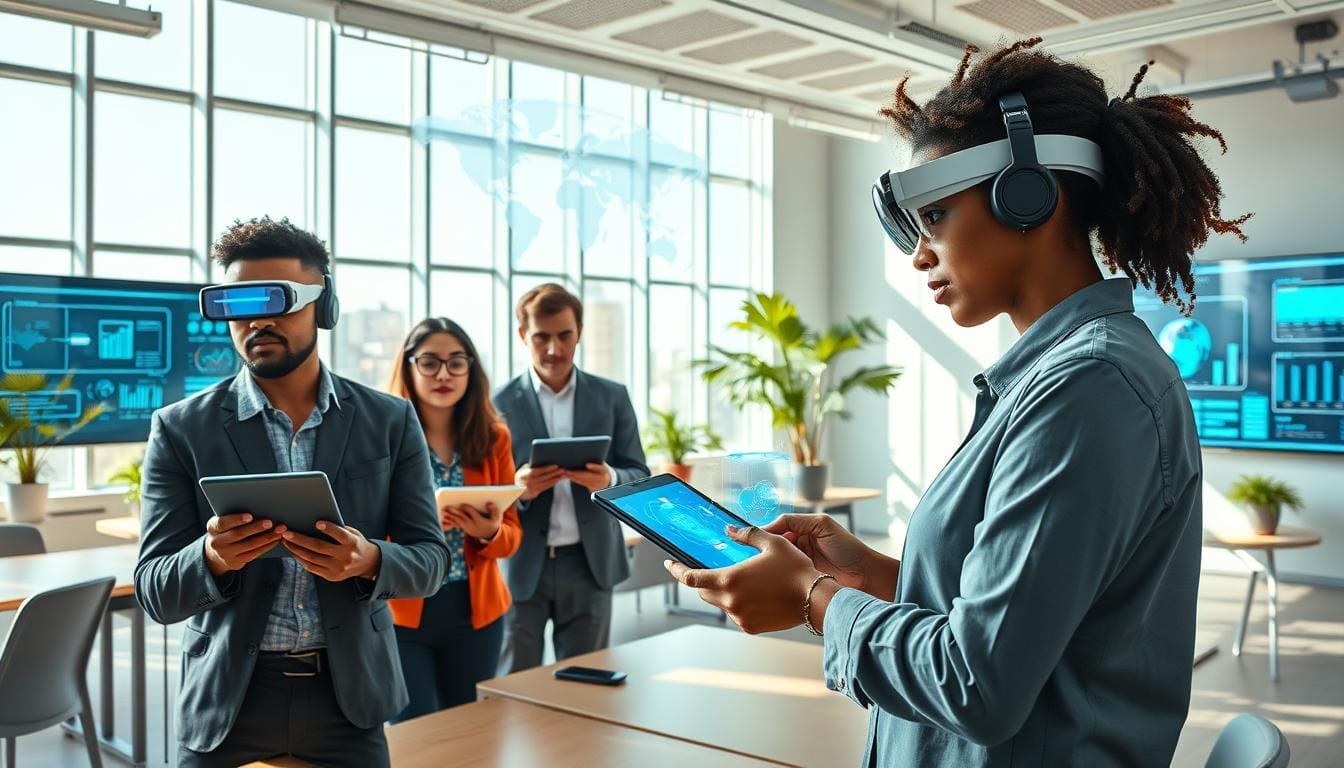
Research reveals that learners are four times faster to train in immersive environments than in traditional classrooms. A spatial computing ai classroom for global workforce upskilling offers the perfect environment to master new talents quickly. You can bridge the gap between theory and practice using advanced digital tools.
These technologies blend physical and digital worlds to create powerful immersive learning experiences for your team. Modern organizations are now moving beyond flat screens to provide hands-on training in safe, simulated spaces. You can practice complex tasks using these technologies that might be too dangerous or costly in real life.
By using these innovative solutions, your workforce gains essential skills through interactive learning. These smart organizations see better retention rates as employees engage with content more deeply. High-quality upskilling ensures your team is ready for the future by building vital skills during training.
Key Takeaways
- Immersive environments accelerate the speed of skill acquisition for employees.
- Spatial tech reduces financial and physical risks during complex training sessions.
- Teams achieve better knowledge retention through hands-on experiential practice.
- Advanced AI classrooms adapt learning paths to meet individual employee needs.
- Digital overlays empower workers to master intricate tasks in safe settings.
- Scalable digital tools help close the skills gap across a global workforce.
The Evolution of Workplace Learning in the Digital Age
You have witnessed a massive shift in how teams acquire knowledge, moving from passive reading to active doing. For decades, workplace education relied on heavy manuals and long lectures that often failed to inspire. Today, organizations are ditching those static methods for dynamic, sensory-driven experiences that truly resonate with the modern professional.
This transformation is not just about moving files to the cloud; it is about changing how we interact with information at work. You now have the power to step into simulated worlds where every action leads to a deeper understanding. This evolution represents a fundamental shift in how businesses approach growth and performance.

From Traditional Training to Immersive Experiences
Traditional training methods often struggle to keep up with the complexity of a modern business environment. Research shows that people typically remember only 10% of what they read. However, when you engage in an experience, that retention rate climbs to an impressive 90%.
The roots of these technologies actually began in the aerospace industry. Engineers built flight simulators for pilot training to ensure safety and spatial awareness. Later, the gaming industry added social interaction and high-end 3D graphics to these virtual environments. Today, these applications allow you to practice high-stakes tasks without any real-world risks.
| Learning Method | Engagement Style | Knowledge Retention | Risk Level |
|---|---|---|---|
| Static Manuals | Passive | ~10% | High in practice |
| Video/Classroom | Limited | ~20-30% | Medium |
| Spatial AI | Active/Immersive | ~90% | Zero Risk |
The Growing Need for Advanced Upskilling Solutions
The digital workforce moves at a lightning-fast pace that demands a new kind of upskilling strategy. You need solutions that can close skills gaps quickly while providing a clear return on investment. Modern technology provides the bridge between current abilities and future requirements.
Immersive tools create realistic spaces where workers can master complex skills through trial and error. This active learning model ensures every employee feels confident before they ever step onto the job site. Forward-thinking companies are already using these methods to drive professional development and stay ahead of the competition.
The evolution from passive to active learning represents a fundamental shift in how businesses approach employee development and skills acquisition.
Experience the future of professional growth where your team doesn’t just watch—they participate. By using these advanced platforms, you can transform your office into a center for innovation and mastery.
Understanding Spatial Computing AI Classroom for Global Workforce Upskilling
Unlock a new era of productivity by integrating a spatial computing ai classroom for global workforce upskilling into your daily operations.
This innovative approach blends physical and digital worlds to create a seamless bridge for professional development.
By using this technology, your business can stay ahead of the curve while empowering employees.
You should explore the [ spatial computing enterprise mixed reality market ] to see how these trends are shaping the future workforce.
These smart spaces allow you to present complex ideas in a way that is both intuitive and highly engaging.
Defining Spatial Computing Technologies
Spatial computing uses various technologies like virtual reality (VR) and augmented reality (AR) to change how we see information.
Mixed reality (MR) takes this further by letting physical and virtual objects interact in real-time.
You can interact with 3D engines and world sensing data to navigate complex digital landscapes safely.
These technologies create realistic environments where your team can practice high-stakes tasks.
Photogrammetry also plays a role by capturing real-world data through photographs to build detailed 3D models.
This foundation ensures that every digital interaction feels authentic and valuable for the user.
The Convergence of AI and Immersive Learning
Combining artificial intelligence with immersive learning creates a smart environment that adapts to every user.
These experiences allow for personalized upskilling across sectors like healthcare, retail, or manufacturing.
The system identifies specific needs and provides immediate feedback during training modules.

This powerful integration ensures that workers in various sectors master complex tasks faster than ever.
AI-driven environments can assess skills gaps in real-time, offering tailored paths for every employee.
You are not just teaching your team; you are providing them with a self-evolving mentor.
Key Components of an Effective Spatial Computing Classroom
An effective learning space requires the right tools, such as high-end headsets and haptic sensors.
High-quality solutions also rely on smart data collection to track progress in the workplace.
Many organizations use these metrics to quantify their success and refine employee skills with surgical precision.
To build a successful classroom, consider these essential elements:
- Hardware: VR/AR headsets and motion-tracking sensors.
- Software: Simulation engines and AI-driven analytics platforms.
- Content: Interactive modules tailored to specific organizational needs.
By choosing the right learning software, businesses can build a resilient team ready for any challenge.
These comprehensive solutions allow you to simulate real-world situations with unprecedented fidelity and safety.
Benefits of Implementing Spatial Computing for Workforce Development
Adopting spatial computing transforms how your team grows and masters new professional challenges. Modern businesses use these tools to identify specific use cases and prioritize investments. By moving away from static manuals, you create a dynamic workplace where innovation thrives.
Implementing these solutions delivers measurable gains across your entire organization. You will see improved outcomes while achieving significant cost savings. This shift from passive to active development ensures your team stays ahead in a competitive market.

Enhanced Knowledge Retention and Engagement
Immersive experiences turn training into a memorable event rather than a chore. Research shows that people retain only 10% of what they read but 90% of what they do. Spatial computing shifts the focus to active participation, which naturally boosts engagement.
Immersive simulations engage visual, auditory, and kinesthetic senses to cement information. Your staff builds emotional connections to the material through these vivid scenarios. This deep connection significantly enhances long-term recall and overall productivity.
Risk-Free Practice in Simulated Environments
You can now allow workers to practice complex or dangerous procedures without any physical danger. Realistic virtual environments provide a safe space for trial and error. This builds confidence before they face high-stakes, real-world situations in their training.
Companies use these tools to increase safety in hazardous settings. Instead of watching videos, each employee learns by doing. This hands-on approach builds vital skills and reduces the risk of costly errors on the job.
Data-Driven Skills Assessment and Personalization
Spatial technologies offer unprecedented visibility into how your workforce performs. You can use data to identify specific performance gaps in real-time. This data allows organizations to target their efforts where they matter most.
Personalized paths created through data analysis ensure everyone receives the exact learning they need. This customized upskilling saves valuable time for both the user and the manager. Every benefits from a more efficient and effective growth strategy.
| Metric | Traditional Training | Spatial Computing |
|---|---|---|
| Knowledge Retention | Low (approx. 10-20%) | High (up to 75-90%) |
| Training Time | Standard Duration | 40% Faster on Average |
| Safety Level | Real-world Risk | 100% Risk-Free |
“The unique technological characteristics of spatial computing offer important benefits that help prioritize investment and target implementations.”
- Build confidence by practicing in risk-free virtual zones.
- Save resources by reducing the average training time by 40%.
- Increase motivation through highly interactive and gamified tasks.
- Achieve precision by using AI to analyze individual performance metrics.
Real-World Applications Across Industries
Forward-thinking organizations now rewrite the rules of professional development. Leading companies in many sectors use spatial computing for immersive learning. These solutions transform your workplace and boost productivity. You can now empower your team with innovative tools that turn vision into reality.
Manufacturing and Engineering Excellence
The migration toward smart factories is transforming the work of engineers. Employees use VR to visualize prototypes and identify design flaws. Boeing trains factory workers to assemble wings using AR technologies. This program helps businesses reduce errors while saving time during production. Digital models allow for rapid iteration and better design outcomes for everyone.

Healthcare Training Innovations
Healthcare is an avid early adopter of these applications across many clinical areas. The Johnson & Johnson Institute uses VR simulations to train surgeons. These tools improve surgical technique scores by 230%. Practitioners gain vital skills in risk-free environments while learning complex procedures. This approach ensures that medical education is both deep and incredibly safe for patients.
Retail and Customer Service Transformation
Retail training allows for realistic practice in safe settings. Walmart uses VR to prepare employees for the chaos of Black Friday sales. Through ai-powered virtual workshops for skill development, your team can gain new skills. This immersive approach helps staff master difficult tasks quickly. You can build a more resilient team that handles high-pressure days with complete confidence.
Safety and Compliance Training
Safety is a priority for every business in the modern world. The NYPD pilots VR to train the workforce in crisis intervention. This technology provides critical information without physical risk. Data from these sessions helps each employee improve. These benefits ensure that companies maintain a safe training environment. By reviewing performance data, you can optimize your safety protocols immediately and keep every worker protected.
| Industry | Leading Brand | Main Benefit |
|---|---|---|
| Manufacturing | Porsche | 40% Faster Upskilling |
| Aerospace | Boeing | Error Reduction |
| Healthcare | J&J Institute | 230% Technique Boost |
| Retail | Walmart | Improved Stress Handling |
Implementing Spatial Computing in Your Organization’s Learning Strategy
Adopting a spatial computing classroom isn’t just about hardware; it’s about rethinking how your team grows. You should evaluate your digital roadmap with colleagues to determine the best path forward.
Staying agile and adaptive ensures your learning solutions remain relevant in a shifting market. You can utilize the learning schedules AI to align with your primary business goals.
Identifying High-Value Use Cases
Start by finding areas where traditional methods fall short. Focus on critical skills gaps that hinder your success today. High-value cases often involve complex work tasks or dangerous environment settings.
By using immersive technologies, you provide employees with safe experiences to master their craft. This targeted upskilling approach ensures your resources provide the most potential for growth. Identifying these needs early helps you build a program that transforms your workplace today. It focuses on skills that require hands-on practice for the best results.
Overcoming Implementation Challenges
Every innovation journey faces hurdles like tech adoption or content development. To win, you need strong executive support and teamwork across your organizations. Leaders must help employees feel comfortable with new tools.
“Innovation distinguishes between a leader and a follower.”
Start with a small pilot to gather data and refine your solutions. This prevents overwhelming your talent while proving the benefits of the technology. Blend immersive scenes with current methods to create a complete learning journey. You must also plan for hardware updates to keep your setup modern and efficient.
Measuring ROI and Training Effectiveness
Establishing clear metrics is vital for showing real value. You must track productivity, error rates, and engagement levels to see growth. Measuring these metrics shows how much future value your training provides.
When employees feel confident, their performance improves across the whole world. An effective plan reduces costs while boosting overall safety and compliance. Gather feedback often to improve the user experience for everyone involved. This data-driven approach proves that businesses can scale their impact effectively.
| Training Factor | Traditional Approach | Spatial Computing Model |
|---|---|---|
| Mastery Speed | Slow due to rote memorization | Fast via muscle memory |
| Safety Level | Exposed to real-world risks | Completely safe simulations |
| Cost Per User | High recurring trainer fees | Low after initial setup |
| Retention Rate | Drops quickly after session | Remains high through action |
Future Trends in Spatial Computing for Global Workforce Development
You are standing on the edge of a revolution where virtual and physical realities merge to enhance human potential. Emerging trends shape a new era of learning that is more powerful and integrated than ever before.
Integration with Other Emerging Technologies
Combining spatial tools with artificial intelligence and machine learning creates sophisticated, adaptive immersive learning environments. These systems analyze performance data to bridge expertise across sectors in real-time. As 5G networks expand, your team can access these solutions from any location. Forward-thinking leaders use these tools to build a resilient environment for their teams to thrive.
Evolving Hardware and Software Capabilities
Recent advancements in haptics let workers feel physical textures and tool resistance during simulations. This realism enhances the benefits of your training program and supports workplace safety. AI-powered virtual humans now act as coaches, providing personalized feedback to employees. Such development ensures employees gain mastery faster.
“In the future, immersive learning will be as commonplace as e-learning today. VR and AR will be essential tools to attract, develop, and retain top talent.”
The Democratization of Immersive Learning
Modern innovation makes spatial devices affordable for businesses of every size. You no longer need massive resources to create custom upskilling content. This shift helps organizations close skills gaps in specific areas and boost productivity in a competitive market. By adopting these applications, you unlock the full potential of your workforce and prepare for the world of tomorrow.
Conclusion: Transform Your Workforce with Hyperspace’s Spatial Computing Solutions
Your journey toward excellence begins with a spatial computing ai classroom for global workforce upskilling. This innovative approach uses artificial intelligence to redefine how modern organizations approach learning. You can now bridge the gap between theory and practice with ease.
Hyperspace provides powerful solutions that deliver real benefits for your workforce. Our program combines immersive learning with data insights to boost productivity. This advanced training model ensures your team stays engaged and motivated through every learning module.
By focusing on upskilling, you prepare your employees for the future in a rapidly changing world. Leaders across all areas trust Hyperspace to help their workers gain vital skills in less time. We empower you to build a resilient team capable of tackling any challenge.
You have the need to transform your workplace and unlock the full potential of every employee. Join businesses across sectors that use our technologies for success in the global market. Stay ahead of industry advancements by choosing a partner that values innovation.
Experience the next level of training through custom experiences in a safe, digital environment. Our solutions are designed to scale with your growth and adapt to your specific goals. The era of traditional training is over; the future is spatial.
Take the first step toward transforming your employees today. Start your free trial of Hyperspace’s spatial computing solutions by visiting http://hyperspace.mv/get-starter.
| Feature | Traditional Training Methods | Hyperspace Spatial Solutions |
|---|---|---|
| Engagement Level | Passive (Video/Text) | Active Immersive Learning |
| Knowledge Retention | Low to Moderate | High through practice |
| Data Insights | Limited completion stats | Comprehensive AI analytics |
| Training Program Scalability | High cost to repeat | Infinite program scalability |