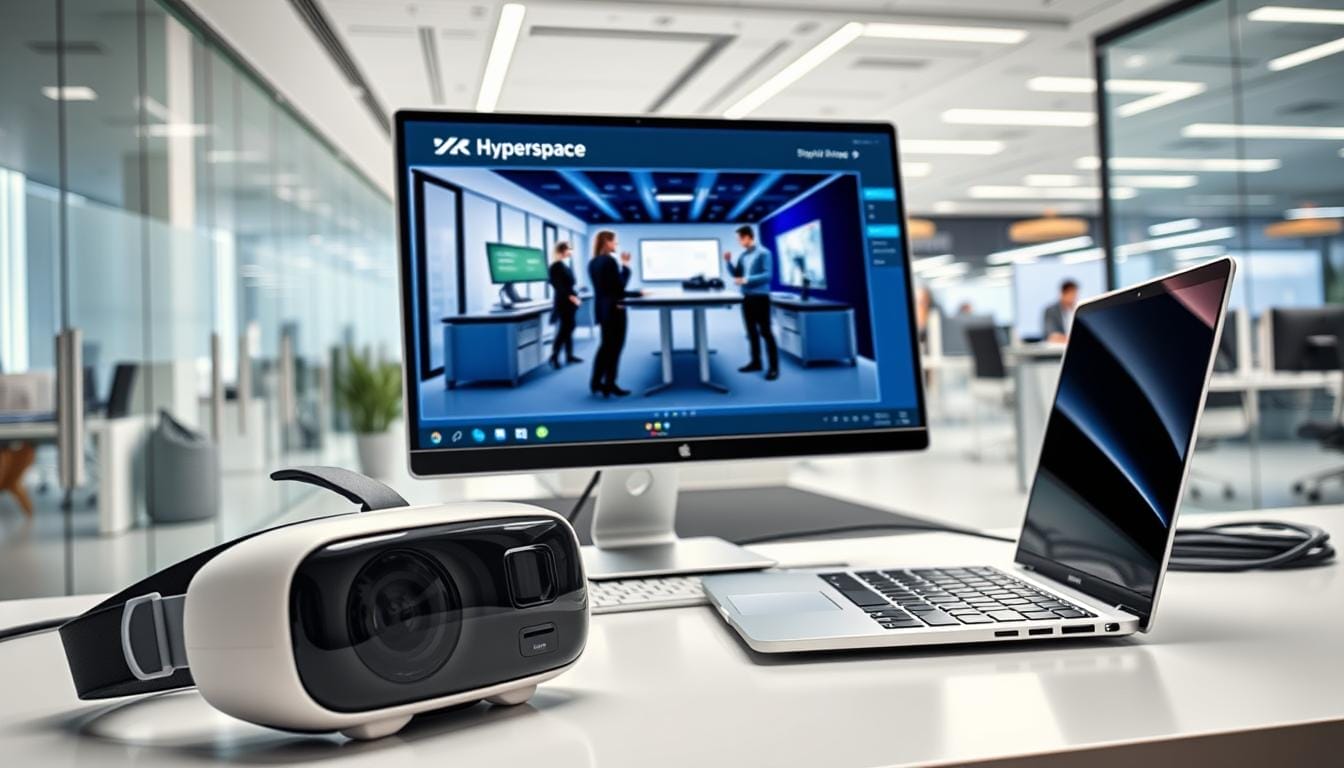
Imagine mastering a complex task without any real-world risks or expensive equipment. VR training software allows your team to practice in safe, simulated spaces that mirror your daily operations perfectly. This modern approach transforms how you build a resilient workforce by blending high-end technology with hands-on practice.
Standard methods often fail to engage modern workers who crave interactive content. By using a digital environment, you can boost knowledge retention and speed up the learning process. You can now build foundational industry skills in a fraction of the time usually required in a classroom.
Immersive experiences provide a unique experience where mistakes are valuable lessons rather than costly accidents. This shift in training strategy ensures your team is ready for any challenge they face on the job. Embrace the future of development and empower your employees to reach their full potential through innovation.
Key Takeaways
- Immersive simulations significantly boost employee memory retention.
- Risk-free environments improve safety for dangerous procedures.
- Scalable digital solutions reduce overall operational costs.
- Interactive coaching helps workers achieve mastery faster.
- Real-time data tracking provides measurable proof of progress.
The Revolution of VR Training Software in Modern Workforce Development

Step into the future of corporate growth where immersive technology turns traditional learning into a powerful, active experience. Virtual reality training represents a massive paradigm shift for your team.
You can finally move away from passive reading and toward active, experiential skill acquisition. Traditional methods often struggle with low engagement and poor knowledge retention.
A modern training platform solves these issues through immersive experiences that feel real. You can now create standardized, repeatable training experiences that your team can deploy globally.
For example, iQ3Connect empowers manufacturing and industrial enterprises to cost-effectively operationalize immersive VR/AR training at scale. This technology bridges the gap between theoretical knowledge and practical application.
Your employees can now practice complex procedures in realistic virtual environments without any real-world risk. This revolution in methodology drives measurable improvements in workforce readiness and operational efficiency.
Finally, these platforms provide unprecedented insights into development through detailed performance metrics. You gain a clear view of competency and safety compliance across your entire organization.
Understanding VR Training Software and Its Core Components
You can transform your workforce by mastering the essential building blocks of immersive learning technology. Modern virtual reality solutions are no longer clunky applications that require complex installations or high-end hardware.
Today, you can access powerful virtual workspaces directly from your web browser with a single click. This seamless use of technology ensures fast, enterprise-wide access on any VR, AR, or 2D device.
Whether your team is in the office or working remotely, they can dive into their modules anytime and anywhere. Since there are no downloads and no app installs, your organization can scale its learning initiatives instantly across different departments.

Key Features of Effective VR Training Platforms
High-quality platforms focus on creating a realistic environment where actions have consequences. These systems often incorporate physics engines that simulate how objects behave in the physical world.
This ensures your training mirrors real-world conditions as closely as possible. You should look for systems that offer the following advanced capabilities:
- Machine learning algorithms that adapt scenario difficulty based on your specific performance.
- Cloud-based deployment models that push instant content updates to all global users simultaneously.
- Granular data capture that analyzes interaction points to identify common mistakes and optimize safety protocols.
How VR Training Software Works
At its core, this software creates digital replicas of your actual workplace or specialized equipment. It uses specialized headsets to track your head and hand movements in real-time.
This technology provides immediate feedback on your performance and decision-making during various experiences. By bridging the gap between digital and physical reality, the software allows you to practice complex tasks safely.
These interactive training sessions turn every movement into actionable data. You gain the confidence to handle high-stakes situations without the risks associated with traditional on-site practice.
7 Benefits of Implementing VR Training Software
You can transform your business results by embracing the unique advantages of immersive virtual environments. Modern technology empowers you to create experiences that were once impossible. These tools help your teams reach peak performance faster than ever before.

Enhanced Learning Retention and Engagement
Immersive environments capture your attention unlike any traditional manual. You learn by doing, which cements knowledge in your memory through active participation. This involvement makes the process an exciting journey rather than a chore.
When you step into a virtual world, distractions disappear completely. You focus entirely on the task at hand, leading to a 75% increase in retention rates. This level of focus ensures your workforce masters new skills quickly and effectively.
Cost and Time Efficiency
You save significant resources by moving your educational programs to a digital platform. By reducing the time and complexity of authoring and deploying virtual experiences, iQ3Connect enables enterprises to lower the cost of ownership.
This streamlined approach maximizes ROI throughout your entire product portfolio. You no longer need to ship heavy equipment or fly employees to central hubs. Digital environments allow for rapid iterations without the high price tag of physical prototypes.
Risk-Free Practice in Hazardous Scenarios
Safety is paramount when your staff works in high-stakes environments. Virtual reality lets you practice dangerous tasks without any real-world physical risk. You can fail, learn from mistakes, and master complex skills in a perfectly safe world.
“The ability to simulate high-stress emergencies without endangering lives is the greatest gift of modern simulation technology.”
This controlled environment builds confidence before employees ever touch live machinery. It reduces workplace accidents and ensures everyone knows exactly what to do when an emergency occurs.
Scalable Training Solutions
Cloud-based solutions allow for the instant deployment of new modules across your entire organization. You can deliver identical experiences to unlimited users simultaneously, regardless of their geographic location. This removes the barrier of physical classroom space.
The technology eliminates instructor variability, ensuring every employee receives the same high-quality training experience. You can easily scale your capacity up or down based on hiring needs. Enterprise tools also support multiple languages to maintain core consistency across global offices.
| Benefit Category | Business Impact | Primary Advantage |
|---|---|---|
| Retention | Higher Skill Proficiency | Learning by Doing |
| Scalability | Global Consistency | Instant Cloud Updates |
| Safety | Reduced Liability | Zero-Risk Practice |
| Efficiency | Improved ROI | Lower Travel Costs |
Real-World Applications of VR Training Software
You are witnessing a fundamental shift in how modern teams build expertise. High-growth industries now use these tools to master complex skills in a digital world.
By using immersive simulations, you can transform theoretical knowledge into practical ability. This evolution is happening across every major sector today.
Manufacturing and Industrial Training
You can now master heavy machinery without stepping onto a busy factory floor. These simulations allow your team to build muscle memory for assembly lines safely.
This process reduces downtime and ensures your staff is ready for live production right away. It empowers workers to innovate and solve problems before they even reach the physical plant.
Healthcare and Pharmaceutical Procedures
Top pharmaceutical companies use the Motive VR Training Platform to replicate their standard steps. Instead of reading books, your scientists get hands-on practice in virtual labs.
This training approach saves significant time and money. It also keeps your senior employees focused on research instead of basic onboarding tasks.
Safety and Compliance Training
Companies use safety training to show workplace hazards and emergency situations without any real danger. This creates immersive experiences for fire response in a controlled environment.
Using VR safety training ensures your safety rules are clear and followed. This training makes compliance learning interactive and keeps your team protected.
- Experience the consequences of safety violations in a safe, virtual space.
- Practice evacuation procedures and fire response with realistic protocols.
- Simulate equipment failures and chemical spills that are too risky for live drills.
Case Study: How Pharmaceutical Companies Transform SOPs with VR Training
Witness how top-tier drug manufacturers are rewriting the rulebook for operational excellence. You can now see a major client in the pharmaceutical sector using immersive technology to master complex Standard Operating Procedures (SOPs).
By creating digital twins of high-tech labs, these companies allow teams to practice in a perfect replica of their workspace. This immersive reality creates a bridge between theory and practice that manual books simply cannot match.
“I love the realism of the training. It was as though I was performing the tasks in real life!”
Challenges in Traditional SOP Training
Traditional SOP training often feels disconnected from the actual job requirements. Static manuals and long videos fail to capture the muscle memory needed for precision lab tasks.
These older methods often leave gaps in understanding. This leads to costly errors and safety risks on the production floor that are hard to correct.
VR Implementation and Results
The implementation captured detailed hand movements from expert performers to ensure every trainee follows best practices. This new training experience integrates compliance checks directly into the virtual simulation.
Organizations now gain the ability to see data from every session. This reveals hidden learning gaps that were previously invisible to instructors.
- Digital Twins: Teams practice in virtual spaces identical to their actual labs.
- Real-Time Feedback: Trainees get instant alerts if they deviate from regulatory standards.
- Expert Precision: Simulations reflect the exact procedural steps of top-performing staff.
- Proven Efficiency: Companies reported 40-60% reductions in total training time.
- Higher Accuracy: Better procedural compliance led to significantly lower error rates.
- Increased Confidence: Users felt more prepared to handle real-world laboratory tasks.
Technical Considerations for VR Training Software
To unlock the full potential of immersive learning, you must evaluate the essential technical pillars of your digital ecosystem. These foundational elements ensure your training programs run efficiently across your entire organization.
Device Compatibility and Requirements
Select hardware that aligns with your specific operational goals. High-end headsets offer deep immersion, while mobile VR provides incredible flexibility for remote teams.
Ensure your network supports these advanced systems to prevent lag. Keeping your team focused on the experience requires a stable and high-speed connection.
Content Creation and Management
Streamline your content management by linking your VR platform to PLM and access control lists. You can deploy your virtual experiences as simple web links to provide access anywhere in the world.
Using single sign-on integration simplifies the login process. It keeps your corporate security protocols intact while allowing users to enter the simulation instantly.
Integration with Existing Learning Management Systems
Sync your immersive data with your current LMS using powerful API capabilities. Standardized formats like SCORM or xAPI allow for a smooth exchange of information between different platforms.
Standardized data exchange ensures that every training milestone and assessment result appears instantly in your central records. This connectivity transforms isolated sessions into a cohesive part of your overall business strategy.
Standardization is the key to scaling innovation across the enterprise.
| Technical Factor | Standard Requirement | Business Benefit |
|---|---|---|
| User Authentication | Single Sign-On (SSO) | Enhanced Security |
| Data Connectivity | API / xAPI | Real-time Tracking |
| Accessibility | Web Link Deployment | Universal Access |
Measuring ROI: Evaluating the Impact of VR Training Software

Visualizing success becomes effortless when you leverage deep analytics to measure the true return on investment for your team. You can finally prove the value of your digital transformation with precise analytics and clear performance reporting.
Evaluating the return on investment for vr training software ROI allows you to scale your programs with confidence. This transparency ensures that every dollar spent translates into a more capable and efficient workforce.
Key Performance Indicators for VR Training
Success in training becomes visible through measurable gains in speed, safety, and accuracy. You can monitor how quickly your team masters complex tasks by looking at completion times and specific error rates.
- VR training platforms capture rich performance data automatically, including completion time, error rates, and procedural compliance.
- Heat mapping and movement tracking provide insights into user attention patterns and procedural efficiency not available in traditional methods.
- Comparative analysis between VR-trained and traditionally-trained cohorts offers compelling evidence of training effectiveness.
Data Collection and Analysis Methods
Your learning programs now generate deep insights within a simulated environment that records every single interaction. You should use multivariate analysis to identify which specific VR elements drive the most significant performance improvements for your staff.
- Longitudinal studies tracking performance over time help your organization understand knowledge retention and skill decay rates.
- Multivariate analysis can identify which specific elements of VR training contribute most significantly to performance improvements.
- Organizations should establish baseline metrics before implementation to enable meaningful before-and-after comparisons.
Implementing VR Training Software in Your Organization
Transforming your workforce through virtual reality starts with a robust roadmap for digital adoption. You have the power to reshape how your staff masters new skills through immersive experiences.
By following a structured approach, you ensure that this innovative training tool delivers maximum value to your business. Let’s explore the essential steps to launch this technology effectively.
Assessment and Planning Phase
Success begins by identifying specific operational gaps where immersive training provides the highest impact. You must evaluate your current infrastructure and define clear metrics for success.
Determine which departments will benefit most from simulated environments before scaling the solution across the company. This stage sets the foundation for your technological evolution.
Deployment Strategies
Choosing the right hardware and software combination is vital for your technical teams. You should start with a pilot program to test the integration within your existing network.
Ensure your IT department is ready to support the hardware requirements and data security protocols. A phased rollout allows you to solve technical hurdles before a full-scale launch.
Change Management and User Adoption
Building enthusiasm is key to making sure every employee feels confident using new tools. You should focus on creating a positive first impression during the initial onboarding process.
- Communication: Share the benefits of VR to build excitement across the organization.
- Leadership: Engage executives to show commitment and encourage adoption at all levels.
- Onboarding: Design intuitive first sessions so the initial interaction is seamless.
- Feedback: Use continuous feedback mechanisms to improve content and technical performance.
- Recognition: Reward successful adoption to sustain momentum during the implementation.
| Implementation Phase | Primary Focus Area | Key Deliverable |
|---|---|---|
| Discovery | Needs Analysis | Strategic Roadmap |
| Technical Rollout | Hardware Setup | Operational Readiness |
| Scaling | User Engagement | Performance Growth |
Future Trends in VR Training Software
You stand at the edge of a new era where virtual environments become more intelligent and accessible than ever before. The next wave of innovation will transform how you interact with digital workspaces, making boundless growth a daily standard. This evolution focuses on removing friction and adding layers of deep, intuitive interactivity.
You will see a shift from simple simulations to ecosystems that breathe and react to your presence. By embracing these changes, your organization can stay ahead in an increasingly digital world. These shifts represent the ultimate transformation of potential into measurable performance within your workforce.
AI and Machine Learning Integration
Imagine a system that understands your pace and adjusts content instantly. AI-driven training will analyze your movements to provide tailored feedback in a shared digital reality. This level of intelligence creates a personalized path, ensuring every employee masters complex skills through adaptive, high-impact interactions that evolve with their progress.
Cross-Platform and Web-Based Solutions
Modern solutions now eliminate the need for cumbersome app installs or long downloads. You gain instant access to workspaces from any device, including headsets or desktop computers. This one-click approach ensures enterprise-wide availability, allowing your team to learn anytime and anywhere without the friction of app store approvals or hardware limitations.
- Web-based VR training tools remove installation barriers for instant browsing.
- Device-agnostic platforms ensure seamless transitions between headsets and mobiles.
- Progressive web applications deliver high performance without store friction.
- Cloud rendering enables complex experiences on less powerful hardware.
- Cross-platform frameworks accelerate content creation for all users.
| Trend | Impact | Primary Advantage |
|---|---|---|
| AI Integration | Systems adapt to user behavior in real-time. | Personalized Learning |
| Web-Based Access | One-click entry via standard browsers. | No Installation Friction |
| Cloud Rendering | Processing happens on remote servers. | High-End Graphics Anywhere |
Comparing VR Training Software Solutions

Empower your organization by exploring the best vr training software platforms currently leading the digital transformation space. Every client we support finds that the right technology bridge turns potential into peak performance through immersive training.
Enterprise-Level Solutions
For organizations operating at a massive scale, enterprise solutions offer unmatched stability and integration. PIXO VR has been an ideal ally for HP as they lead the way in providing complete XR solutions for global business. These platforms focus on robust management tools and seamless training deployment across thousands of users simultaneously. You gain a powerful infrastructure that grows alongside your company’s evolving digital landscape.
Industry-Specific Platforms
If you need specialized results quickly, industry-focused platforms provide a head start with targeted content. These tools excel at delivering precise safety training by using pre-built environments that mirror your specific workplace. You can implement high-quality training modules without the long wait times of custom development.
- These platforms offer pre-built content libraries tailored to sectors like healthcare or energy.
- Specialized features address unique requirements like medical simulations or industrial safety.
- Content incorporates industry-specific equipment models and environments.
- Compliance features align with specific regulatory frameworks.
- Purpose-built workflows ensure faster implementation for your team.
- Providers offer specialized expertise in your specific sector’s challenges.
Hyperspace: The Comprehensive VR Training Solution
Hyperspace stands as the premier choice for organizations ready to redefine how their teams learn and grow. You can finally move beyond static slides and 2-D videos to embrace a truly dynamic environment. This platform empowers you to create realistic simulations that mirror your specific workplace challenges without needing complex coding skills.
By choosing this solution, you are not just buying software; you are adopting a vision for a smarter workforce. The intuitive design ensures that your team focuses on the curriculum rather than struggling with the technology. It is time to elevate your training standards and achieve the excellence your business demands.
You can transform your organizational culture by making learning an engaging, daily adventure for everyone involved. Innovation starts with the right tools. These tools allow you to bridge the gap between classroom theory and real-world application instantly.
Innovative Capabilities for Tomorrow
Our no-code architecture allows you to build custom worlds quickly and efficiently. You can scale your immersive training programs globally with a single click, reaching every employee regardless of their location. This accessibility ensures that geographical barriers no longer hinder your organizational growth.
The platform provides real-time data tracking to monitor progress and identify learning gaps immediately. This high-level safety training capability ensures that your workers are prepared for high-risk tasks without any physical danger. You gain peace of mind knowing your team is ready for any challenge.
Proven Success and Real-World Impact
Every client we partner with sees immediate, tangible improvements in their operational metrics. For instance, a global manufacturer slashed their safety incidents by 43% using our modules. Another partner reduced their onboarding time by 60% while simultaneously boosting retention. These results prove that modern training methods deliver a significant return on investment.
- Healthcare systems reported a 35% reduction in procedural errors through virtual simulation.
- Pharmaceutical manufacturers achieved 100% regulatory compliance using interactive modules.
- Energy companies saved $2 million annually by replacing expensive field-based sessions.
Hyperspace transformed our approach to skill development with their intuitive interface and responsive support.
| Industry Sector | Key Metric | Performance Gain |
|---|---|---|
| Manufacturing | Incident Rate | 43% Improvement |
| Corporate HR | Onboarding Speed | 60% Faster |
| Energy | Annual Costs | $2M Savings |
Conclusion: Transform Your Workforce Training Today
The future of career growth has arrived through the power of immersive digital worlds. Virtual reality is no longer just a concept; it is a major advantage for your workforce. By using these solutions, you can improve how people learn while you lower total costs.
Many companies making vr ar job training central to see huge gains in productivity. These immersive experiences help teams master new skills in a safe, digital reality. Hyperspace leads this change with a platform that is strong and very easy to use.
Do not let your training programs fall behind the curve. Start your journey today by visiting http://hyperspace.mv/get-starter for a free trial. Transform your business training into an exciting path that drives real results.
| Strategic Advantage | Business Impact |
|---|---|
| Active Engagement | Higher knowledge retention rates |
| Risk-Free Practice | Reduced workplace safety incidents |
| Rapid Scaling | Consistent global learning standards |
| Resource Efficiency | Lowered travel and equipment expenses |